Medicine for All People: One Integrative Physician’s Quest to Make Medicine Whole
By Nic Dahl
Geeta Maker-Clark, MD, completed the Fellowship in Integrative Medicine in 2010. Over the past 16 years, she has carried the discipline into medical schools, family medicine clinics, Chicago public-school classrooms, food justice and writing fellowships, and on stage at international conferences. What began as an interest in healing-oriented medicine has grown into a meaningful medical career that encompasses justice, movement, culinary arts, purpose and belonging.
In her debut book, Medicine for All People: Science and Ancient Wisdom for Revolutionary Healing, Maker-Clark weaves those threads into a vision of medicine that extends beyond diagnosis and prescription to include culture, nourishment, community, relationships and meaning.
For Maker-Clark, the phrase “medicine for all people” is not a catchy slogan. It is her calling and her argument. She grew up in an Indian American household where conventional and cultural medicine coexisted naturally. Her father, a surgeon, championed the biomedical model. Her mother practiced a form of healing ingrained in the household: turmeric and honey for scrapes, warm foods for colds, and an herb-stocked kitchen. This dual approach to healthy living shaped her sense of what medicine could be.
Following in her father’s footsteps, she attended medical school and later, family medicine residency. After a few years as a maternal health staff physician, Maker-Clark found herself wanting more. She was looking for a program that could be completed in tandem with practice and focus on the definition of medicine she grew up with, one that emphasized healing. In 2008, she discovered and enrolled in the University of Arizona Integrative Medicine Fellowship, a two-year, part-time, remote program at theAndrew Weil Center for Integrative Medicine (AWCIM). From the first module, she recognized that integrative medicine offered a framework for reconciling the two strands of her upbringing. At the Andrew Weil Center for Integrative Medicine, physicians train in traditional, lifestyle and mind-body medicine, as well as clinical nutrition, supplements, and botanical medicine.
Within the fellowship, Maker-Clark found both a community and the confidence that she could transform medicine from within. Over the two years, her cohort met three times in-person for what are called CME experiential retreats, and she was assigned a clinical mentor to help guide those approaches within their specialty and the modern health care system. Nearly 20 years later, this group of physicians, NPs, PAs, dentists, and pharmacists are still some of Marker-Clark’s closest friends and colleagues.
After completing the Fellowship in Integrative Medicine, she went on to co-develop the University of Chicago’s Culinary Medicine Program and create Food Is Power, a community initiative, into Chicago Public Schools. Her work has included roles as director of integrative nutrition and advocacy at Endeavor Health and clinical assistant professor at the University of Chicago’s Pritzker School of Medicine, alongside her daily work as an integrative family physician. She also was selected to be in the inaugural Castanea Fellowship for food systems leaders and later received the Mesa Refuge Michael Pollan Fellowship in Food Journalism.
Across those settings, Maker-Clark kept returning to the meaning of “medicine.” In her clinic and work with students, she encountered people for whom the word evoked fear. Yet medicine, as she had come to know it, encompassed both the surgeries her father performed and the salves and soups her mother prepared, as well as nature, community, plants, gratitude, play, and dance, all within the broader framework she found in integrative medicine.
“To me, really, medicine is anything that helps restore life,” Maker-Clark says. And she is on a mission to reclaim that meaning for practitioners, patients and all people.
With the release of Medicine for All People, AWCIM spoke with Maker-Clark about reclaiming that definition, the fellowship experience that altered her course, and why food, justice, dance, and purpose are not peripheral to health care, but central to it.
This conversation has been edited and condensed for length and flow.
AWCIM: You are a physician, food justice advocate, dancer, educator and mother. How do you answer the question, “Who is Geeta Maker-Clark?”
GMC: When I think about my identity, the first thing that comes to mind is being a mother. Being a mother has brought out the best parts of me, the parts that are centered on helping, guiding, healing and loving in the world. I’m also a seeker. I’m a seeker of love. I’m a seeker of justice. I’m a seeker of truth, and root cause. This curiosity and deep desire to learn led me to integrative medicine and to writing this book.
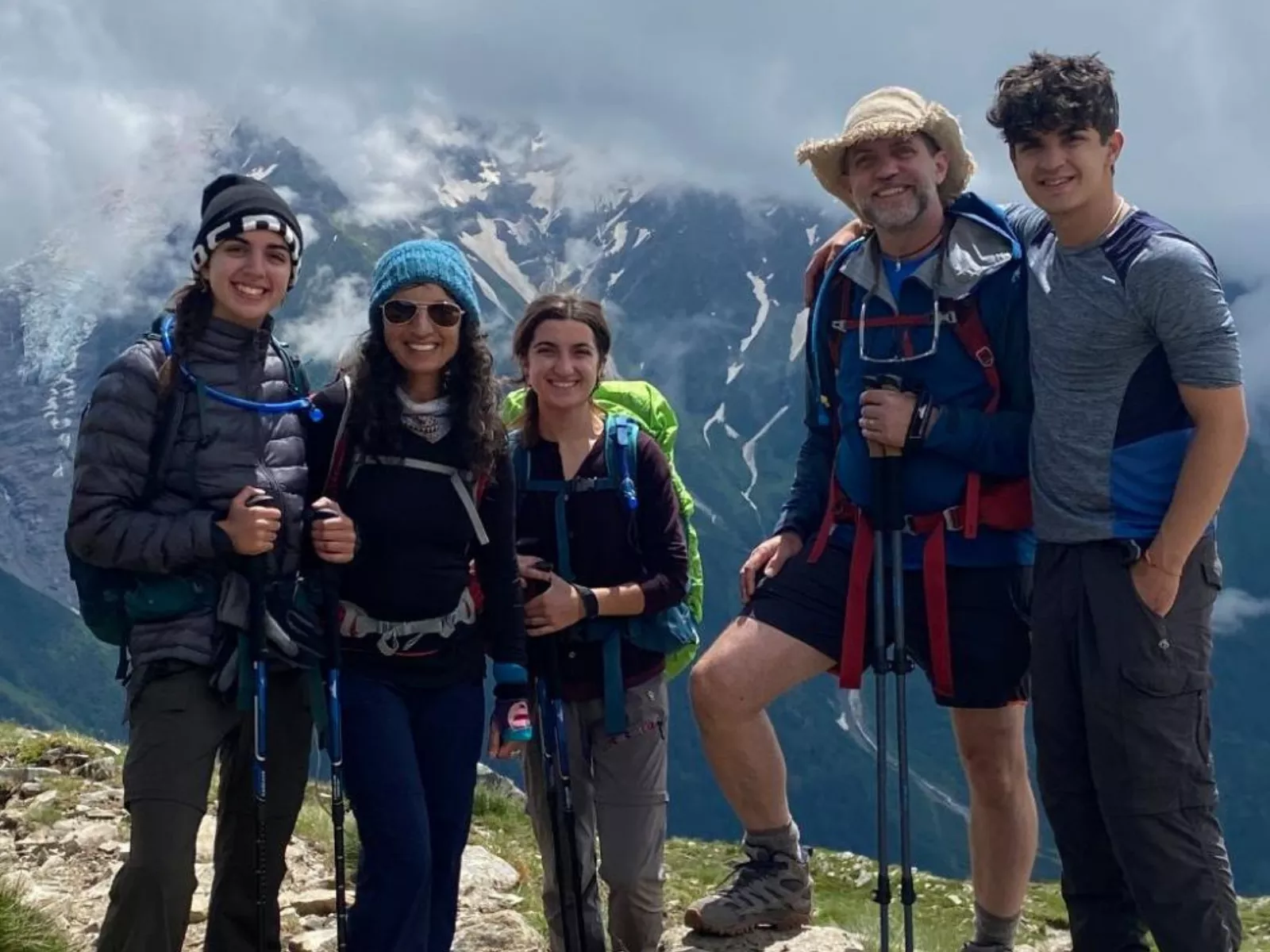
Dr. Maker-Clark and her family in nature. Photo courtesy of Geeta Maker Clark, MD.
AWCIM: Your book is called Medicine for All People, but you’ve spoken about the fear and negative associations the word “medicine” can carry. Why was it important to reclaim that word?
GMC: That is a beautiful question. Medicine is something that helps restore life. The earliest origins of what we consider health, healing and medicine were restorative, reviving, rejuvenating and reparative. Over time, we as clinicians can fall into a pattern of asking, “What is wrong with you?” or “What can I give you to fix that broken thing?”
The questions we should also be asking are: “What nourishes you? What needs to return to your life? What are the conditions that allow you to flourish? What happened to you?”
Those answers lead us to the medicines that help make a person feel whole. A diagnosis, prescriptions, procedures and disease management are essential and lifesaving. I respect them as a physician. But alone, they are not enough.
We cannot medicate our way out of problems that are social, ecological, spiritual and structural.
What I’m calling for is a return to a broader understanding of medicine, one that includes ancestral wisdom, body and spirit, community, science and the conditions of our daily lives.
AWCIM: Your understanding of medicine began long before medical school. How did growing up in an Indian American family shape the physician you became?
GMC: My parents were born in India, in a region that is now in Pakistan. When the land was divided, they became refugees in their own country and had to leave our ancestral lands and home and many traditions rooted in agriculture as they escaped to the city. That experience changed our family’s story permanently.
I was born in Chicago, and grew up in a household that very much preserved our Indian value system. My mom cooked almost entirely Indian food with some random American items mixed in!. Indian cuisine is based in Ayurveda, the science of living. The idea of food as medicine is built into our culture. The cumin, coriander, mustard seeds, turmeric, the way the onions are prepared combined with them, it all serves a purpose. When I felt sick, my mom would say, “Here, eat this.” If I had a cut, we might put turmeric and honey on it.
At the same time, my father is a surgeon and a champion of the biomedical model if there ever was one. He saved many lives each day and I wanted to be like him. He’s an incredible healer, and he showed me the path medicine could take me. But I also wanted to be a healer like my mom.
That was my worldview of medicine. I saw the power of both paths and how they could coexist.
Later, I trained in Ayurveda in India and with teachers here in the United States. The Integrative Medicine Fellowship greatly expanded my knowledge and expertise in traditional medicine. All of it now sits comfortably in the way I take care of people. I have a vast toolbox, and I’m grateful to my culture for gifting these practices for me to help people with.
“We cannot medicate our way out of problems that are social, ecological, spiritual and structural.”
— Geeta Maker-Clark, MD
AWCIM: You completed the Integrative Medicine Fellowship over 15 years ago. What did the field feel like in the early 2000s?
GMC: 15 years. Wow.
Back then, it felt like we were defining and creating something that was so far outside mainstream medicine. It was an incredibly energizing time. As fellows, we felt like we were building on the foundation laid by Dr. Weil, Dr. Maizes, Dr. Low Dog and all the people who came before us and believed that we, as clinicians, had the potential to change the way we define medicine.
Twenty years later, I feel like the integrative medicine movement did its job so well, that many of the ideas the field uplifted are now widely accepted in medicine, and in popular culture. Integrating lifestyle medicine in clinical settings, personalized health, systems biology, health optimization and longevity all reflect ideas that have long been part of the integrative medicine movement.
I feel a great deal of pride when I reflect on what the Center was able to do to shift the culture. What was started at the Andrew Weil Center for Integrative Medicine gave many health care professionals the foundation, confidence and expertise to go out and make significant changes in their institutions and ecosystems.
The transformation of the American health care system is going to be a low, slow, long burn. Integrative medicine was there at the start, and we will see it through.
Dr. Maker-Clark with Dr. Weil, founder of integrative medicine. Photo courtesy of Geeta Maker Clark, MD.
AWCIM: You’ve called the Fellowship an inflection point in your career. What did it give you that you didn’t have before?
GMC: The Fellowship was not only an inflection point in my career, but also in my life.
It offers an incredible amount of knowledge, teaching and connection. But it also offers community, a sense of belonging and the opportunity to feel like you’re part of something meaningful and expansive and that is vitally important.
That community is the most important aspect of the Fellowship.
I’ve stayed close to so many of my fellow fellows and people from other fellow classes. I’ve worked with them on projects and collaborated with them across the country over the last 20 years.
On a very personal level, the Fellowship gave me the confidence that I could make change in the system where I worked.
And I did.
I started the culinary medicine program after the Fellowship and the Food Is Power program in Chicago Public Schools. I ran huge food-as-medicine CME symposiums at my institution, the first ones offered to the public as well. I changed the food offerings in the hospital system for staff and patients. Having the expertise and the Fellowship behind me allowed me to speak from a place of authority and knowledge that I didn’t have before.
It mattered a lot. And helped me get things done!
AWCIM: After everything you’ve learned since then, how would you define integrative medicine today?
GMC: Medicine made whole.
AWCIM: Wow. That is a great response. Some integrative principles that once felt unusual are now part of mainstream medicine. At the same time, we’re in an era of exclusive wellness and biohacking. Has something been lost in translation?
GMC:Integrative medicine teaches that some of the most powerful medicines are ancient and accessible: food, sleep, breath, movement, nature, community, being of service to others.
The problem I see with much of biohacking is that it turns health optimization, healing and wholeness into a luxury marketplace. It sends a dangerous message that healing requires expensive devices, tests, supplements, trackers and very specific routines. I also don’t like the word hacking, since the body is not a machine!
That doesn’t negate technology and testing. They have a place and can help move data forward in understanding what humans need to be well. But wellness should never be something only people with money can access. We’ve lost our purpose if that’s the case. To me, integrative medicine has always represented a more democratic vision of healing.
AWCIM: One of the central ideas in the book is a “medicine pouch.” Can you explain what that is?
GMC: A medicine pouch is a way of describing the wisdom, practices, relationships and rituals that we can carry with us to help us be healthy and heal. In ancestral traditions, there is often a vessel in which people carry meaningful or sacred objects close to the body: seeds, stones, herbs, medicinal plants, prayers or photographs. They are symbols of protection and belonging.
I use the medicine pouch as a metaphor for the things we need to remember and reclaim. I intentionally offer it as something different from a protocol or a particular model of healing. There are so many books promising the perfect cure, the best diet, the detoxification path.
Instead, the medicine pouch asks: “What helps me return to myself? What nourishes me? What steadies me? Which of these medicines do I want or need in my pouch?”
Each chapter is a medicine, and the reader is invited to put that medicine into their pouch if it speaks to them, something they can carry into daily life.
It’s a way to remember.
AWCIM: Can you give me an example of what using a medicine pouch looks like in clinical practice?
GMC: I write about a patient I was fortunate to work with, a nurse who came to see me with extreme exhaustion, anxiety and depression, and chronic pain. She had four young children, was homeschooling them, working night shifts at the hospital and carrying a lot of responsibility within her extended family.
This is not an atypical patient for family doctors. I’ve been seeing women like this for 25 years, women who are doing so much for so many and holding up the backbone of their families and communities. So much of the toll of those responsibilities goes into their bodies and spirits.
She was already on an antidepressant and had seen other doctors, but she was still feeling poorly. Part of what we do as integrative physicians is listen to patients and make space for both their medical history and their story. As I listened to hers, what came to me was that she had given birth to four children and had never really been given the chance to restore and replenish herself before returning to caregiving and responsibility.
In her culture and in mine, and in many cultures, there is a concept of cuarentena, a period of roughly 40 days after birth when a mother stays home, is cared for and fed, rests with her baby and focuses on healing. In Ayurveda, we say “40 days for 40 years,” because those 40 days are considered so important to a woman’s long-term health.
Modern postpartum care doesn’t always support that kind of restoration. Many women go back to work quickly, at home and professionally. There can almost be a badge of honor attached to how quickly you ‘bounce back’ after having a baby.
I said to her, “You have 40 days times four worth of restoration that you weren’t able to have. And it’s not too late.”
We worked together on nourishment and rest, setting boundaries and delegation of responsibilities, breathwork and herbal teas. We brought her family into the plan, and they were eager to support her. Her medicine pouch filled with nourishing food, herbal medicine, family and community support, and gratitude for the beautiful life she had created.
She was able to find her life force again through those medicines.
It is never too late to fill your medicine pouch.
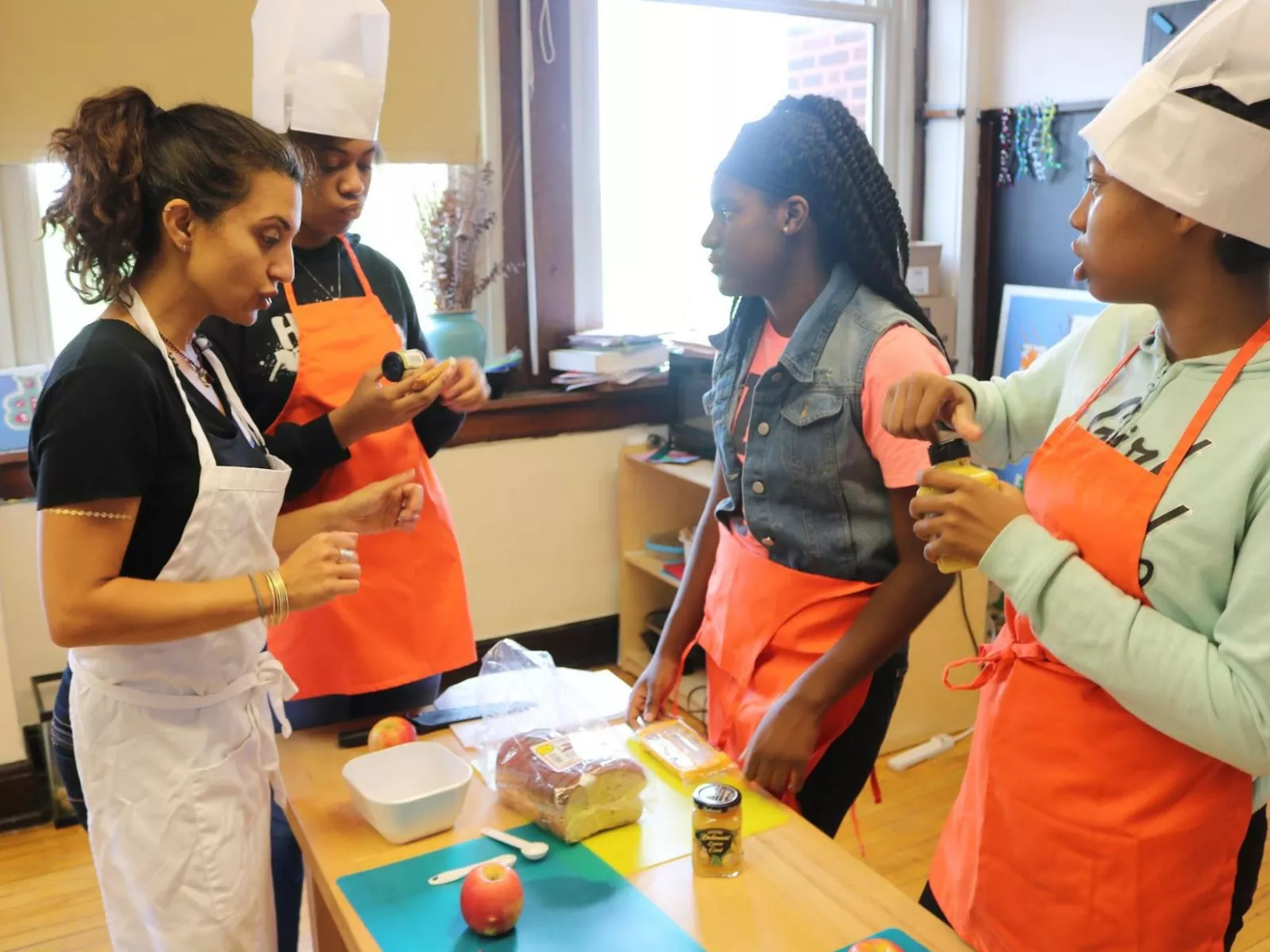
Maker-Clark with students enrolled in the “Food is Power" program, a culinary and nutrition education initiative. Photo courtesy of Geeta Maker Clark, MD.
AWCIM: You’ve said health cannot be an individual construct. Where does justice fit into your definition of medicine?
GMC: I speak about this at every conference. People definitely wonder, “Why is this doctor talking about a living wage?”
I focus a lot on the collective, and on justice as a medicine, because we cannot talk about healing without talking about the conditions in which people live.
Even if people have access to medications, procedures and pharmaceuticals, if they don’t have safe housing or healthy food, if the air where they live isn’t clean, if the education system is broken or if there’s no economic security from a living wage, then we cannot have a healthy society.
Unjust systems become biology.
They shape stress and inflammation, chronic disease and mental health, life expectancy and the outcomes we look at when we talk about a healthy society.
I return to this at the end of the book, in the epilogue on justice and love. I present the idea that policy is a form of love. This is how we can love people: by creating and advocating for policies that allow all people to flourish.
“Unjust systems become biology.”
— Geeta Maker-Clark, MD
AWCIM: Dance has its own “medicine” in the book. Why is movement so central to your work?
GMC: Dance has been a vital medicine to me. It is a particular joy to share it in the book, in the communities I work with and with my patients.
No one needs to teach you how to dance. All of us are born dancers. There is so much joy in it, so much expression and release.
And yet people don’t always think about dancing as vital. Maybe they’re nervous about it or feel like they’re not good at it. Maybe they’ve been socialized to believe it isn’t appropriate. Dance has been outlawed in so many cultures for hundreds of years. A great way to exert power over people is to figure out where they feel their most joyful and powerful and take that away. Our ancestors kept dance alive for us in basements, alleys, behind barns, wherever they could do it freely.
So, to me, dance is medicine on so many levels. It’s joyful. It’s spirit-filled. It’s accessible to all. It’s free. And then, of course, there’s the science. There’s good research showing that dance increases neuroplasticity, improves cognition and reduces dementia risk.
AWCIM: There’s a term you use for what happens when people gather and move together: “collective effervescence.” What does that mean to you?
GMC: Ooh, yes. When I first heard that term, it gave me a pause.. It’s a good phrase, isn’t it? It had a lot to do with propelling me to write this book. I thought, “If there is a word for this feeling, for what happens when people gather and feel a shared aliveness, that’s what I want to write about.”
Collective effervescence.
I love it.
AWCIM: Speaking of good phases, we are seeing the phrase “whole person” more commonly adopted in medicine. What does this mean to you as an integrative physician?
GMC: It means that a patient is a whole person. We are seeing and caring for the full human being and their full human experience which includes their story, their nervous system, their culture, their ancestry, their family, their community, their spirit.Whole-person care is also grounded in the idea that we are not separate.
We are not separate from nature.
We are not separate from each other.
We are not separate organ systems.
We are interconnected, sophisticated human beings built for flourishing. And that’s my job as a doctor, and our job as a society: to help create the conditions for all people to flourish.
AWCIM: When someone finishes Medicine for All People, what do you hope they understand differently about medicine, and what do you hope the book becomes for them?
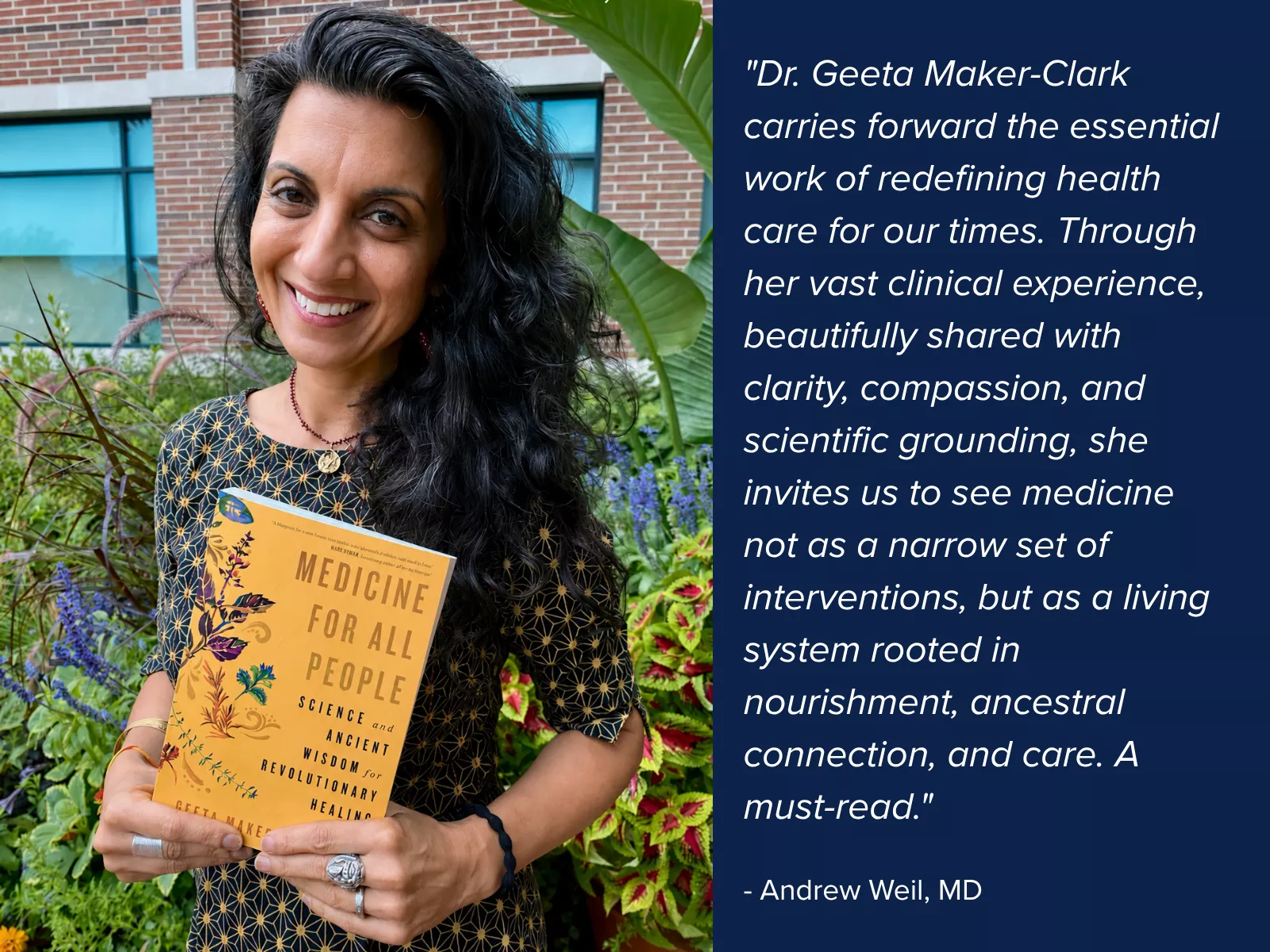
GMC: I hope this book is the seed of a movement towards equitable, beautiful, loving health care. And I hope the book becomes a companion.. One of those guides you keep beside you, at your bedside or in your backpack, that you can go to as a medicine pouch for yourself.
Something to remind you of who you are. To remind you of what matters. To keep you full and energized for your work in the world.
Because the purpose of these medicines is not to fix you or fix something that is broken.
It is to help you nourish what you’ve forgotten.
“The purpose of these medicines is not to fix you or fix something that is broken. It is to help you nourish what you’ve forgotten.”
— Geeta Maker-Clark, MD
The Integrative Medicine Fellowship met Maker-Clark at a formative point in her career, giving structure to an expansive understanding of healing and connecting her with others who saw possibility in practicing medicine differently. It also gave her, she says, the confidence to make good changes within the health care system.
And that she did. With Medicine for All People, Maker-Clark turns that concept outward, asking readers to see healing not as something only accessed in a clinic, but as a medicine we can recognize, reclaim and make more available to one another.
Medicine for All People is available worldwide through Penguin Random House and booksellers. Maker-Clark will return to the Andrew Weil Center for Integrative Medicine in March for the 2027 Integrative Medicine Conference, where she will lead an experiential culinary medicine session.